Content Attributes
Pick up any introductory renewable energy textbook and you’ll find a three-blade horizontal axis wind turbine on the cover. That configuration so thoroughly dominates the wind industry that most people assume it’s the only serious option. It isn’t. Vertical axis machines have a longer commercial history than most people realise. Some configurations handle conditions that HAWTs struggle with. Calling one better than the other misses the point — they solve different problems, and the engineering behind each reflects that.
How a Horizontal Axis Turbine Works?
Walk past any wind farm and you’re looking at HAWTs. Three blades on a horizontal shaft, rotor facing the wind, nacelle sitting at the top of the tower with the gearbox and generator inside. It’s been the industry standard long enough that most people don’t know there’s an alternative.
HAWTs run on lift, not drag. That distinction matters more than it sounds. The blades are shaped like aircraft wings because they’re doing the same job — generating a pressure difference across two surfaces to produce force perpendicular to the airflow. Pushing against the wind like a sail is far less efficient. A HAWT blade is never fighting the wind. It’s flying through it.
Efficiency is the HAWT’s strongest argument. The theoretical maximum efficiency for any wind turbine is 59.3%, a figure known as the Betz limit. Modern utility-scale HAWTs operating in good wind conditions reach 45 to 50% of available wind energy. That’s significantly higher than what most vertical axis designs achieve in practice.
The trade-off for that efficiency is real. The nacelle, gearbox, generator, and yaw system all live at the top of a tower that might be 100 metres tall. Maintenance teams work at height on every service visit. A blade replacement job needs a specialist crane, good weather, and a planned outage. Those aren’t dealbreakers for a utility wind farm with trained crews and long-term service contracts. For a smaller installation without that infrastructure, they’re significant constraints.
How a Vertical Axis Turbine Works?
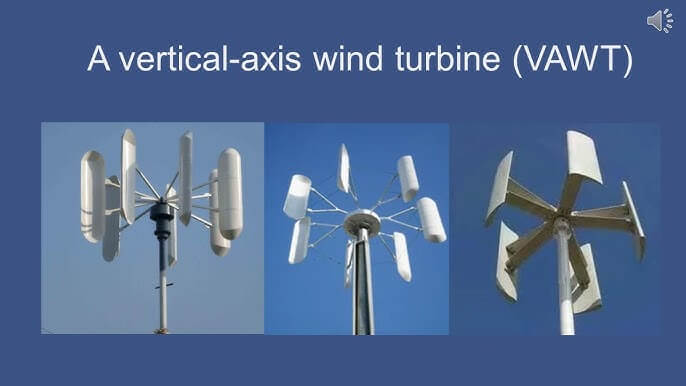
A vertical axis wind turbine, or VAWT, mounts its rotor on a vertical shaft. Two designs dominate the VAWT category. The Savonius uses curved scoops that catch the wind through drag. It starts turning at very low wind speeds, which is useful, but its efficiency ceiling sits around 15 to 20%. That limits it to low-power jobs: small ventilation units, remote sensors, teaching demonstrations. The Darrieus is different — curved aerofoil blades that generate lift as they spin, closer in aerodynamic principle to a HAWT than to its Savonius cousin.
The Darrieus is more capable. It generates lift rather than drag, giving it a higher efficiency ceiling than the Savonius, though still below utility-scale HAWTs in practice. Its defining structural advantage is that the generator and drivetrain sit at the base of the tower. That makes maintenance significantly simpler and allows heavier drivetrain components without tower loading penalties.
The VAWT’s most practically useful feature is omnidirectionality. It accepts wind from any horizontal direction without a yaw system. In urban environments or locations with highly variable wind direction, that matters. A HAWT in turbulent, multidirectional urban airflow spends energy yawing and loses efficiency. A VAWT is indifferent to direction changes.
Where Each Design Makes Sense?
IRENA’s Wind Energy Data 2023 puts global installed wind capacity past 2,000 GW. Most of that is utility-scale HAWTs. That’s not inertia — it reflects four decades of cost reduction, supply chain development, and operational learning that no other wind configuration has matched. When you can manufacture blades at scale, train crews to service them, and finance projects against a deep track record, the economics reinforce themselves.
But utility scale is not the only relevant context. A wind turbine installed on a university campus for research and student training has different requirements than one feeding a national grid. Small wind applications, remote off-grid installations, and urban deployments all present conditions where the VAWT’s lower maintenance burden, omnidirectionality, and quieter operation are genuine advantages.
Noise is a practical consideration that rarely gets adequate coverage in technical comparisons. HAWTs produce aerodynamic noise from blade tip vortices, and that noise scales with tip speed. VAWTs typically operate at lower tip speeds and generate less tonal noise. For installations near occupied buildings, that difference is not trivial.
A Question of Context, Not Supremacy
HAWTs dominate commercial wind energy for good reasons. They are more efficient, better understood, and backed by decades of operational data at scale. That makes them the right choice for most large installations where maximising energy output is the primary objective.
VAWTs are not failed HAWTs. They are a different set of trade-offs that suits a different set of applications. Rooftop installations, research platforms, low-maintenance remote deployments, locations with chaotic wind regimes: in these contexts, a vertical axis design isn’t second-best. It’s the more appropriate engineering choice.