Content Attributes
India’s logistics system is changing fast. One of the most important changes inside Indian Railways is the growth of the private freight terminal (PFT). Under Indian Railways’ PFT policy, private companies can build and run modern freight terminals on private land (and in some cases railway land) with their own investment, while Indian Railways provides rail connectivity and train haulage.
For shippers, this means faster handling of cargo, lower logistics cost and better end-to-end service. For investors, it means a chance to develop integrated logistics parks connected directly to the rail network. For Indian Railways, PFTs bring in private capital, help decongest old goods sheds, and increase freight revenue.
In this detailed guide, you will learn:
- What a private freight terminal in Indian Railway actually is
- How the PFT policy works and why it was created
- The difference between private freight terminal and private siding
- A practical list of private freight terminals in India and key operators
- How a company can plan and develop a new PFT
- Future opportunities linked to Dedicated Freight Corridors and Gati Shakti
Throughout the article, we use simple language but rely on official Indian Railways circulars, Parliamentary replies and policy documents to keep the information accurate and trustworthy.
What is a Private Freight Terminal?
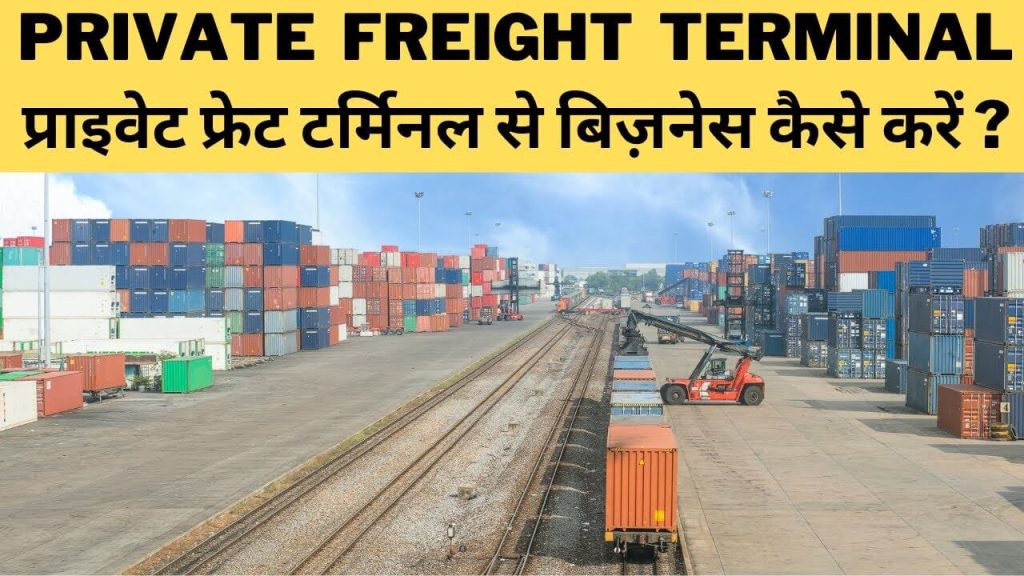
A private freight terminal is a rail-connected logistics facility developed and operated by a private player, usually on private land, under the Private Freight Terminal (PFT) policy of Indian Railways. According to Railway Board policy and explanatory notes, a PFT is set up by a Terminal Management Company (TMC) with its own investment. The terminal is connected to the nearest railway station by a siding track so that freight trains can directly load and unload cargo inside the terminal.
Key features of a private freight terminal
A typical private freight terminal in India offers:
- Rail sidings for loading and unloading of wagons and container rakes
- Hardstanding area and internal roads for trucks and trailers
- Warehouses, silos or covered sheds for safe storage of cargo
- Equipment such as reach stackers, cranes, forklifts and weighbridges
- Office space and IT systems for documentation, billing and tracking
- Value-added services like packaging, palletisation, stuffing/de-stuffing and sometimes customs-related services
The idea is to create a “one-stop logistics hub” where a customer can bring goods by road, handle them inside the PFT, and dispatch or receive them by rail with minimum delay.
How a PFT works with Indian Railways?
Under the PFT policy, Indian Railways and the private freight terminal operator share responsibilities:
- The private party invests in land, track within the terminal, buildings, equipment and operations staff.
- Indian Railways provides and maintains the main line, signalling and locomotive haulage of rakes to and from the terminal.
- The operator collects all customer charges at the terminal (handling, warehousing, local services) and pays agreed charges to Railways such as terminal access charges or other fees as per the policy.
PFTs can handle almost all types of rail-borne traffic:
- Containers (export–import and domestic)
- Coal, cement, steel and minerals
- Foodgrains and fertilisers
- Automobile and white-goods rakes
- Other bulk or break-bulk cargo
Earlier, many industries depended on congested railway goods sheds or had to build individual private sidings. The private freight terminal model offers a middle path: modern facilities developed by private players but open to multiple customers, integrated with the national rail network.
Private Freight Terminal Policy in Indian Railways
Indian Railways issued the first Private Freight Terminal Policy in 2010 and later revised it in 2012 and 2015. The main purpose was to attract private investment for rapid development of freight terminals and to provide efficient, cost-effective logistics solutions to end users.
Objectives of the PFT policy
Official policy documents and press releases highlight some clear objectives:
- Expand terminal capacity quickly without putting full burden on Railway finances
- Integrate rail with the wider supply chain, including warehousing and road transport
- Offer end-to-end logistics services to industries in mineral belts, manufacturing clusters and agriculture regions
- Reduce logistics cost in India by shifting more cargo from road to rail
- Decongest existing goods sheds and goods yards of Indian Railways
- Increase freight market share of Railways through better customer service
Under the scheme, Railways invites proposals from private investors. Once a proposal is found technically and financially feasible, the zonal railway issues “in-principle approval” and later notifies the terminal as a PFT after conditions are met.
Evolution and scale of PFTs
Early press releases showed just a handful of PFTs – six private freight terminals notified in the initial years. Over time, the number of proposals and terminals increased. For example:
- A Parliamentary reply noted 18 proposals under the scheme, with several terminals at locations like Bamanheri, Nabha, Rudrapur, Wardha, Tadali, Kalamboli and Somathane getting in-principle approval or being notified.
- Later updates and Railway marketing circulars show many more proposed and operational PFTs across different zones, often linked to large industrial customers or container operators.
Alongside PFTs, Indian Railways has introduced the Gati Shakti Cargo Terminal (GCT) policy, which is conceptually similar and also relies heavily on private investment. Recent current-affairs notes mention dozens of GCTs already operational and targets for hundreds more. This creates a broader ecosystem of rail-based freight terminals where private freight terminal operators play a central role.
Difference Between Private Freight Terminal and Private Siding
Many logistics managers in India ask about the difference between private freight terminal and private siding. Both are connected to the railway network and both involve private investment, but they serve different purposes. Understanding this difference is important before deciding which option suits a particular business.
What is a private siding?
In classical railway terminology, a siding is a low-speed track off the main line used for loading, unloading or storing wagons. Indian Railways documents describe several types of sidings – private, assisted, public and defence – depending on who pays for them and who can use them.
A private siding is generally:
- Constructed and fully financed by one industrial unit, like a steel plant or power station
- Situated inside or very close to that industry’s premises
- Used mainly for that owner’s cargo, not open to general public traffic
- Operated under a siding agreement that defines charges, responsibilities and safety norms
Private sidings are excellent when one large customer has consistent, high-volume traffic (for example coal to a power plant). But they are not usually designed as shared logistics hubs.
How is a private freight terminal different?
A private freight terminal is conceptually closer to a shared logistics park:
- Multi-user facility: PFTs are open to multiple customers and multiple commodities, not just one industry.
- Broader services: They combine sidings with warehouses, container yards, truck parking, offices and value-added logistics services.
- Business model: The operator earns from handling charges, storage, value-added services and sometimes from real-estate-like activities, while also paying charges to Indian Railways.
- Policy framework: PFTs are governed by a specific PFT policy with standard procedures for approval, notified status, concession period and incentives.
- Location flexibility: Though many are near large industries, a private freight terminal can also be located near industrial clusters, agricultural mandis or ports, serving several smaller shippers.
Which is better for your business?
If your company is a single large plant with predictable, high-volume inward and outward flows (e.g., cement, steel or power), a private siding might be enough. But if you:
- Serve multiple customers,
- Want to attract third-party cargo, or
- Plan to build a logistics park or inland container depot,
then a private freight terminal in Indian Railway network usually offers more flexibility and better revenue potential. In practice, some projects combine both concepts, with a siding that also functions as a PFT or Gati Shakti terminal under the relevant policy.
List of Private Freight Terminals in India & Major Companies
The exact list of private freight terminals in India keeps changing as new terminals are approved and commissioned. Indian Railways maintains an online dashboard and FOIS portal where users can see terminals zone-wise, state-wise and district-wise, including private freight terminals and other goods terminals.
Examples of private freight terminals
Official zone documents and circulars show PFTs and container terminals at locations such as:
- Bamanheri (Uttar Pradesh) – Central Warehousing Corporation’s private freight terminal
- Kalamboli (Maharashtra) – CWC terminal handling container traffic
- Somtane (near JNPT, Maharashtra) – Navkar Corporation terminal
- Tadali and Wardha (Maharashtra) – serving steel and industrial cargo
- Rudrapur (Uttarakhand) – for industrial and FMCG traffic
- Nabha (Punjab) – agri and food-related traffic
- Timmapur (Telangana) – notified as a private freight terminal in South Central Railway
- Khapri, Borkhedi and other locations in Nagpur region – private terminals and container terminals handling Coal, steel and containerised cargo
Different zones like Central Railway, East Central Railway and others publish PDF lists of PFTs and Gati Shakti cargo terminals from time to time. For the latest, it is always best to check the FOIS “Freight Terminals Dashboard” or contact the concerned divisional office.
Private freight terminal companies in India
Several logistics and infrastructure companies are active as private freight terminal companies in India, either directly operating PFTs or running container train terminals that function similarly. Documents from Indian Railways and industry associations highlight players such as:
- Container Corporation of India (CONCOR)
- Central Warehousing Corporation (CWC)
- Adani Logistics and other Adani group entities
- Gateway Rail Freight Ltd
- Hind Terminals Pvt Ltd
- DP World Multimodal Logistics
- Allcargo Terminals, Ameya Logistics, Apollo Logisolutions and other CFS/ICD operators
- Regional logistics firms operating dedicated PFTs or Gati Shakti cargo terminals along the Dedicated Freight Corridors
Many of these companies combine PFT operations with container train services, warehouses and road fleets, creating end-to-end logistics solutions for customers.
How to Plan and Develop a Private Freight Terminal?
For businesses and investors, the big question is: how do you actually develop a private freight terminal in India? Training material and presentations used for Indian Railways officers outline a clear planning process for new sidings and PFTs.
Below is a simplified, step-by-step view.
Step 1: Assess traffic potential and site
- Study current and future cargo volumes – coal, steel, containers, grains or mixed traffic – within a catchment radius of 50–150 km.
- Identify industries, warehouses, mandis and ports that could use the terminal.
- Shortlist locations with good highway access and availability of land near existing railway lines.
Step 2: Prepare a concept note and approach the zonal railway
- Draft a short project concept: location, land details, estimated cargo, proposed layout and investment.
- Approach the concerned Divisional or Zonal Railway office with this note.
- Railways will check technical feasibility (gradient, track capacity, signalling, safety) and provide initial feedback.
Step 3: Detailed project report and approvals
- Prepare a detailed project report (DPR) covering track layout, buildings, equipment, cost, timelines and environmental aspects.
- Submit formal application under the PFT or Gati Shakti policy as relevant.
- After scrutiny, the zonal railway may issue “in-principle approval.”
- Additional clearances (land use, environment, local bodies) must be obtained by the developer.
Step 4: Construction and connectivity
- Build internal tracks, yards, sheds, warehouses, roads, drainage and utilities according to approved plans.
- Indian Railways or the developer (as agreed) completes the connecting line from the nearest station to the terminal boundary.
- Install handling equipment, weighbridges and IT systems for billing and tracking.
Step 5: Commissioning and operations
- After inspection, the terminal is notified as a private freight terminal by the Railway Board or zonal railway.
- Commercial operations start: booking, loading, unloading, storage and despatch of trains.
- The operator signs necessary agreements on charges, responsibilities and performance standards.
- Continuous improvement in turnaround time and customer service keeps the terminal competitive.
By following these steps carefully and working closely with Indian Railways, a company can turn a greenfield site into a productive private freight terminal serving an entire region.
Future of Private Freight Terminal in India
The future of the private freight terminal ecosystem is closely linked to India’s larger infrastructure programmes – especially the Dedicated Freight Corridors (DFCs) and PM Gati Shakti.
Dedicated Freight Corridors and PFTs
Reports on the DFCs note that 14 private freight terminals are planned along the Eastern and Western corridors with an estimated investment of around ₹2,800 crore. These terminals will form part of multi-modal logistics parks that connect high-speed freight lines with factories, ports and warehouses.
Each terminal is expected to:
- Offer fully mechanised handling of container and bulk rakes
- Cut transit time significantly due to higher train speeds
- Reduce the unit cost of freight movement and improve reliability
As more sections of the DFCs become operational, demand for modern private freight terminals in adjoining industrial regions is likely to grow.
Gati Shakti cargo terminals and logistics policy
The Gati Shakti Cargo Terminal (GCT) policy extends the basic idea of PFTs with a strong multi-modal focus. Official updates and current-affairs summaries mention dozens of GCTs already commissioned with plans for hundreds more, many developed by major logistics and industrial groups.
For private investors this means:
- More structured frameworks for developing terminals on railway or private land
- Better integration with national logistics plans, industrial corridors and ports
- Opportunities to serve not just rail cargo but also road, coastal and inland waterway flows
Why PFTs matter for Indian businesses?
From a business point of view, a well-run private freight terminal offers:
- Lower freight cost by shifting cargo from long-haul road to rail
- Faster and more reliable service due to dedicated infrastructure
- Better inventory control through on-site warehousing and IT systems
- Environmental benefits, because rail generates less emissions per tonne-km than road
- Room for expansion, as more customers and commodities can be added over time
With India targeting a higher rail share in freight traffic by 2030 and heavily investing in new tracks and terminals, private freight terminals are likely to stay at the heart of the country’s logistics transformation.
FAQs on Private Freight Terminal in Indian Railways
A private freight terminal is a rail-connected logistics hub developed and operated by a private company under Indian Railways policy. It has its own yards, warehouses and equipment and handles cargo and trains for multiple customers, while Indian Railways provides the main rail network and locomotive haulage.
Any eligible private player – such as a logistics company, industrial group, port operator, warehouse company or consortium – can propose a PFT, provided it meets policy conditions, proves traffic potential and obtains all approvals from the concerned zonal railway and government authorities.
A private siding is usually built for one large industry and serves mainly that industry’s cargo, while a private freight terminal is a multi-user logistics facility open to several customers and commodities. The PFT includes broader services like warehousing, container yards and truck handling and operates under a dedicated PFT or Gati Shakti policy.
The most reliable source is the Indian Railways FOIS Freight Terminals Dashboard and related PFT/GCT lists published by zonal railways. These online tools show terminals state-wise, zone-wise and division-wise, including private freight terminals, goods sheds and Gati Shakti cargo terminals.
PFT operators earn from handling charges, storage fees, container and wagon operations, value-added services (packing, labelling, consolidation), lease of warehouses and sometimes from commercial developments in and around the logistics park. At the same time, they pay agreed charges to Indian Railways for track access, haulage and other services, as laid down in the PFT or GCT policy.