Content Attributes
Few fixtures reshape a bathroom’s character as completely as a freestanding tub. The oval silhouette, in particular, has stayed relevant across both traditional and contemporary interiors because it balances visual softness with structural confidence. Its continuous curves feel intentional without being imposing.
What many homeowners overlook, though, is that the shape carries genuine spatial consequences. Understanding which layouts actually support it and which ones fight it makes the difference between a bathroom that feels designed and one that simply has an expensive tub in it.
Why the Shape Matters?
Bathroom fixtures don’t exist in isolation. Each one interacts with floor space, wall proximity, and the paths people take through the room every day. The oval form has an advantage here: its tapered perimeter and absence of hard corners allow it to settle into a wider range of layouts than rectangular or slipper-style alternatives.
Shoppers comparing oval freestanding tubs often notice that the shape reads as less imposing even when the actual footprint is generous. That’s not an illusion. The eye follows a curve differently than a right angle, and the continuous line around an oval distributes visual weight more evenly across the room. This quality makes it a reliable choice in spaces where clearance is tight but a bold fixture is still desirable.
Layouts That Suit This Silhouette
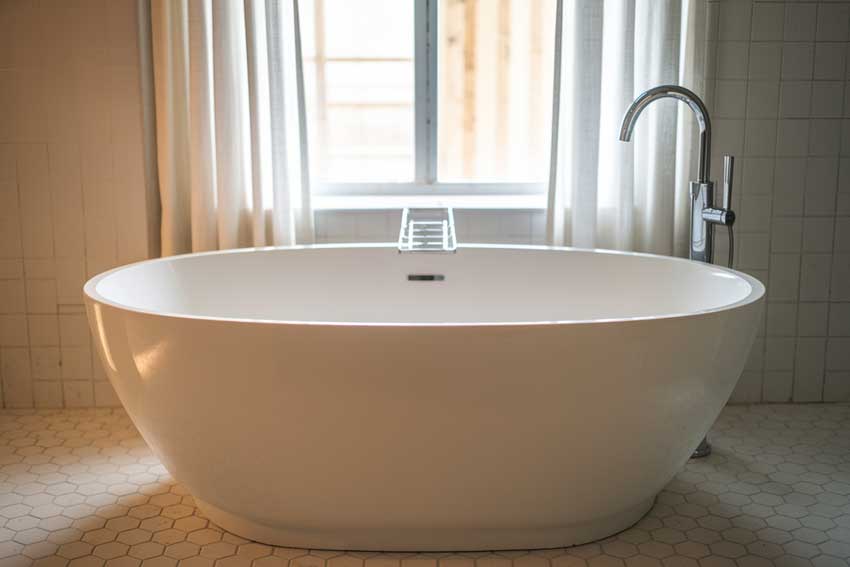
Centered Placement in Larger Primary Bathrooms
In bathrooms with ample square footage, positioning the tub at the room’s center is both practical and visually effective. Open floor space on all sides lets the oval’s full form read clearly, and that clarity is part of the appeal.
Industry guidelines typically suggest at least 24 inches of clearance on each side. In practice, pushing the primary entry side to 30 or 36 inches improves day-to-day usability considerably, especially during cleaning.
Against a Window Wall
A window-facing placement suits the oval silhouette particularly well. The shape’s natural symmetry aligns with a centered window opening, creating a composed, balanced wall that doesn’t require additional styling to feel finished.
Light from above or behind the tub accentuates the curves, especially on white and matte surfaces. For privacy concerns, high window placement or obscured glass resolves the issue without sacrificing the daylight that makes this layout worth choosing in the first place.
In a Dedicated Wet Room or Open-Plan Bath
Wet rooms have become more common as bathroom design has shifted away from compartmentalized layouts. An oval tub is well suited to this format because it needs no wall anchoring and no built-up surround. It simply sits within a finished, fully waterproofed space and functions more like a piece of furniture than a fixed utility.
That framing matters. In a wet room, the tub becomes the room’s focal point, and the oval form handles that kind of exposure better than shapes with more angular geometry.
Narrow Bathrooms With a Long Axis
Elongated bathrooms can be awkward to furnish, but the oval tub handles the format well when oriented along the room’s long axis. Positioned at the far end from the entry, it pulls the eye through the space rather than stopping it.
A feature wall directly behind the tub (in tile, stone, or a contrasting finish) reinforces this effect. The oval acts as an anchor rather than an afterthought, and the narrow room reads as intentionally dramatic instead of just long.
Clearance, Plumbing, and Surface Considerations
Freestanding tubs require floor-mounted fillers or wall-mounted deck fillers set at the correct height. Plumbing supply lines need to be placed before the floor goes in; moving them after tiling is expensive and disruptive.
Surface material also plays a role. Continuous finishes like large-format porcelain, stone, or polished concrete complement the oval without visual competition. Busy mosaic patterns tend to draw attention away from the tub rather than toward it.
Weight is worth assessing early. A filled tub places significant load on the subfloor, and older homes may need structural reinforcement before installation.
Conclusion
The oval freestanding tub earns its reputation through genuine versatility. It performs well in centered open layouts, window-facing arrangements, wet rooms, and elongated spaces, provided the floor area and circulation needs of the room are accounted for first. The fixture rewards thoughtful placement. When the layout supports it properly, the result isn’t just a bathroom with a beautiful tub. It’s a space where every element feels like it was always meant to be there.